
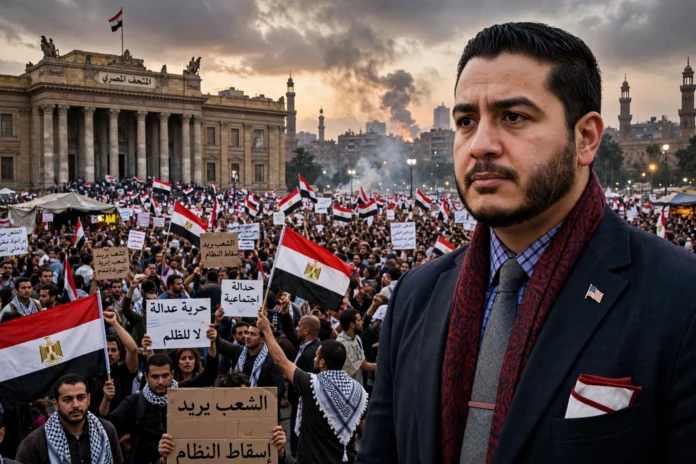

Strip away the campaign rhetoric from both sides and examine the documents, and a hard claim survives: Michigan Senate candidate Abdul El-Sayed has a paper trail connecting him to the Muslim Brotherhood. The evidence does not prove that he carries a Brotherhood membership card, and nobody should pretend otherwise. It does establish something politically relevant on its own: documented support for the Brotherhood when it held power in Egypt, a family history described by his own half-sister as a Brotherhood history, a mother who worked for a charity later designated for supporting al Qaeda and Hamas, and a father-in-law embedded in the leadership and donor network of American organizations that federal prosecutors tied to the Brotherhood during the Holy Land Foundation case.
That is not guilt by religion. It is guilt by signature, family record, association, and money.
First, understand what the Muslim Brotherhood is
The Muslim Brotherhood was founded in 1928 in Ismailia, Egypt, by Hassan al-Banna, a schoolteacher who believed Muslim decline had been caused by Western colonialism, secular government, and abandonment of Islamic law. His answer was not merely a political party. The Brotherhood built a complete alternative society: mosques, schools, clinics, businesses, youth organizations, labor groups, and eventually a paramilitary wing. Its famous credo declares: “Allah is our objective. The Prophet is our leader. Qur’an is our law. Jihad is our way. Dying in the way of Allah is our highest hope.”
The Brotherhood’s objective was an Islamic state governed by sharia, first in Egypt and ultimately across the Muslim world. Al-Banna’s method combined public preaching and social services with organization and discipline. Alongside the public movement stood the Secret Apparatus, responsible for assassinations and bombings. In December 1948, a Brotherhood member assassinated Egyptian Prime Minister Mahmoud Fahmy el-Nokrashy. Al-Banna himself was assassinated two months later, almost certainly in retaliation by state security forces.
After Egypt’s 1952 revolution, the Brotherhood initially cooperated with the new military regime, then collided with Gamal Abdel Nasser. A Brotherhood member attempted to assassinate Nasser in 1954, producing mass arrests, torture, and executions. Out of those prisons came the man whose writings supplied modern jihadism with much of its operating theory.
Sayyid Qutb wrote Milestones in 1964. Qutb argued that supposedly Muslim societies had returned to jahiliyya, the ignorance that existed before Islam, because they were governed by man-made laws instead of God’s sovereignty. A faithful vanguard therefore had to separate itself, organize, and ultimately remove those regimes, by force where necessary. Nasser hanged Qutb in 1966, but the book escaped the prison with his followers.
The Council on Foreign Relations has written that Qutb’s work “provided the intellectual and theological underpinnings for many militant Sunni Islamist groups, including al-Qaeda and Hamas.” That is not a rhetorical flourish. Ayman al-Zawahiri, later Osama bin Laden’s deputy and successor, was formed in the Egyptian Islamist circles shaped by Qutb. Abdullah Azzam, a Muslim Brotherhood member who became bin Laden’s mentor during the Afghan jihad, carried Brotherhood ideas into the transnational network that became al Qaeda. Hamas made the connection explicit. Founded in Gaza in 1987 by Sheikh Ahmed Yassin and other Brotherhood activists, Hamas stated in Article Two of its 1988 charter: “The Islamic Resistance Movement is one of the wings of the Muslim Brothers in Palestine.”
This is why the Brotherhood matters to any serious history of modern terrorism. It did not personally direct every later jihadist organization, and groups such as al Qaeda and ISIS eventually attacked the Brotherhood as insufficiently revolutionary. But the Brotherhood created the mass organizational model, the ideological vocabulary, and many of the people from which modern Sunni jihadism emerged. It was the trunk from which several poisonous branches grew, even when some branches later turned against the trunk.
The Brotherhood also learned to compete electorally. After Hosni Mubarak fell in 2011, its Freedom and Justice Party won Egypt’s parliamentary and presidential elections. Mohamed Morsi became president in June 2012. That November, facing judicial challenges, Morsi issued a constitutional declaration placing his decisions beyond court review. Mass protests followed. Egypt’s military removed him in July 2013. Egypt, Saudi Arabia, the United Arab Emirates, and Russia have designated the Brotherhood as a terrorist organization. The United States has not designated the worldwide movement as a single entity, in part because its branches differ, but it has designated Hamas and specific Brotherhood chapters and affiliates.
That is the organization Abdul El-Sayed publicly supported at a decisive moment.
Exhibit One: his own signature
On November 25, 2012, days after Morsi placed his decrees beyond judicial review, a public letter published by Al-Ahram Gate defended the Brotherhood president and urged him to “purge the media and the police as quickly as possible.” Abdul El-Sayed was the 33rd signatory, listed as “Dr. Abdul Rahman El-Sayed.” He was not a child and this was not an ambiguous petition about democracy in the abstract. He was a Columbia medical student putting his name to a call for an embattled Muslim Brotherhood president to purge state institutions during an authoritarian power grab.
That signature is the strongest evidence in the entire case because it does not depend on a relative, a donor, or an interpretation by one of El-Sayed’s opponents. It is a primary document bearing his name.
The year before, El-Sayed had written for the Huffington Post urging the United States to support Egypt’s protesters while downplaying Western concerns about the Brotherhood’s ambitions. His position was therefore not an accidental signature on somebody else’s letter. It formed part of a consistent early record: minimize fears of the Brotherhood before it took power, then defend its president after he took power and attempted to place himself above the courts.
El-Sayed now says, “I clearly disavow” the Muslim Brotherhood. What he has not supplied, in the reporting on the letter, is an explanation of the letter itself. He has not said he signed it without reading it. He has not said he misunderstood what “purge the media and the police” meant. He has not renounced his support for Morsi’s decree. A campaign-era disavowal delivered after the document resurfaced is a political statement. It is not an accounting.
Exhibit Two: the family record
El-Sayed’s half-sister is Eman Abdelhadi, a University of Chicago professor. In posts from 2012 and 2013, she wrote: “My family has long been MB,” meaning the Muslim Brotherhood. She described their mother as a Brotherhood activist at Alexandria University in the early 1970s and wrote about relatives who had been jailed for Brotherhood membership.
El-Sayed responds that his parents divorced when he was three, that he was raised in Michigan by his father and stepmother, and that he never discussed the subject with his mother. He calls his half-sister’s account hearsay. Notice what that defense does and does not do. It establishes distance from his mother. It does not establish that Abdelhadi invented the family history, and El-Sayed has not directly disputed that she wrote what she wrote.
His mother’s employment adds context. Fatten Fathy Elkomy worked for the Islamic American Relief Agency. In 2004, the United States Treasury designated the organization for supporting al Qaeda and Hamas. Elkomy was never charged with a crime, and employment by an organization is not proof that every employee shared its illicit activities. But when a candidate’s defenders ask voters to dismiss the entire subject as an invention, the mother’s employment at a designated organization is a relevant part of the record.
None of this means a son inherits his mother’s politics. El-Sayed’s own signature is what turns family background from biography into corroboration. The views he expressed as an adult point in the same direction his half-sister described.
Exhibit Three: the American network and the money
El-Sayed’s father-in-law, Tayeb Jukaku, sits on the Founders Committee of the Islamic Society of North America, or ISNA. That is a leadership and major-donor body, not the same thing as being one of ISNA’s literal founders in 1982, a distinction that matters and is worth keeping straight. Jukaku was also president of the Michigan chapter of the Council on American-Islamic Relations, CAIR, from 2005 to 2010.
ISNA and CAIR became central figures in the Holy Land Foundation prosecution, the largest terrorism-financing case in American history. Federal prosecutors named both organizations unindicted co-conspirators and presented evidence connecting them to the Brotherhood’s American network and to the Holy Land Foundation, which was convicted of funneling more than $12 million to Hamas. Neither ISNA nor CAIR was charged or convicted, and both dispute the government’s characterization. But “unindicted” does not mean the federal case invented the association from nothing. It means prosecutors chose to prove the crimes of the foundation and its leaders rather than prosecute every organization named in its evidence.
Jukaku is not merely a distant in-law with an old title. He contributed $300,000 to Fighting for Michigan, the super PAC supporting El-Sayed, making him its largest individual donor identified in the reporting. The money did not go directly into the campaign account, another distinction worth keeping straight. It went to the legally independent organization spending money to elect him. Politically, the conclusion is the same: one of the principal financial patrons of El-Sayed’s Senate bid is his father-in-law, a longtime figure in organizations that federal prosecutors placed inside the Brotherhood’s American support network.
Exhibit Four: the pattern of what he will not say
The Brotherhood evidence does not end with Egypt. It is reinforced by El-Sayed’s repeated instinct to avoid direct condemnation of Islamist actors until political pressure makes silence impossible.
After Ayatollah Ali Khamenei was killed, a leaked recording captured El-Sayed’s campaign discussing the political problem rather than the dead dictator. El-Sayed said there were many people in Dearborn who were sad and that he did not want to comment on Khamenei at all. The planned response was to attack Donald Trump instead. Khamenei was not a Muslim Brotherhood figure; he led the rival Shiite Islamist regime in Iran. The tape therefore does not prove another Brotherhood tie. It proves the method: when asked to condemn an Islamist ruler, calculate the constituency first.
He used the same method after a Hezbollah-inspired attacker rammed a truck into Temple Israel in West Bloomfield, a synagogue that also houses young children. El-Sayed condemned the violence, then added the context that the attacker’s family had been killed by an Israeli airstrike and observed, “Hurt people hurt people.” He later apologized and conceded that the moment had not called for context. The apology was appropriate. It does not erase the instinct that produced the original statement.
Then there is Hasan Piker, who appeared on stage at El-Sayed’s Ann Arbor rally. Piker has said Hamas is “a thousand times better” than Israel, said he would vote for Hamas over Israel “every single time,” praised Hezbollah’s flag because it carries an AK, and once said America deserved 9/11 before apologizing for that remark. Hamas is not adjacent to the Brotherhood in some abstract ideological sense. By its own charter, it is the Brotherhood’s Palestinian wing. El-Sayed has distanced himself from Piker since the primary without fully repudiating the decision to campaign with him. Two Democratic officials, Representative Hillary Scholten and State Senator Jeremy Moss, withheld endorsements over precisely that association.
A candidate is not responsible for every sentence spoken by every supporter. He is responsible for the people he elevates to his stage and for whether he can say, plainly and without a strategy call, that a terrorist organization and its propagandists are beyond the line.
The conclusion the documents support
The fair conclusion is not that investigators have uncovered a secret Brotherhood membership roll with Abdul El-Sayed’s name on it. They have not. Anyone claiming that level of proof is overstating the record.
The record does prove the following. As an adult, El-Sayed signed a public letter supporting Mohamed Morsi’s power grab and urging the Brotherhood government to purge the media and police. Before that, he publicly downplayed concerns about the Brotherhood. His half-sister described their family as longtime Brotherhood, and their mother worked for an organization the Treasury Department designated for supporting al Qaeda and Hamas. His father-in-law held leadership positions in ISNA and CAIR, organizations named by federal prosecutors in the Holy Land Foundation case, and then became the largest individual donor to the super PAC supporting El-Sayed. Since entering the Senate race, El-Sayed has avoided condemning Khamenei, contextualized a Hezbollah-inspired attack on a synagogue before apologizing for doing so, and campaigned on stage with a streamer who openly prefers Hamas, the Brotherhood’s Palestinian branch.
One item might be a youthful mistake. Two might be coincidence. A signature, a family history, a designated employer, a leadership network, a $300,000 super PAC contribution, and a continuing pattern of evasions are not a coincidence. They are a record.
El-Sayed is entitled to explain that record. Michigan voters are entitled to judge it. What neither he nor his defenders are entitled to do is pretend the record does not exist.