
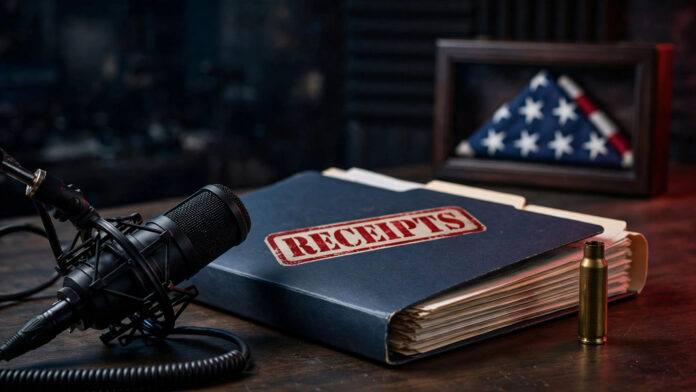

On October 26, 2026, Tucker Carlson released a nearly two hour interview with Matt Cubbler under the title “Murder, Drugs and Cover-Ups: Military Insider Exposes the Criminal Cartel Within the US Navy SEALs.” The title is the verdict. The interview is the sentencing hearing. What never shows up, in two hours, is a trial.
Cubbler is not a random internet theorist. He is an Army veteran, a retired police officer, and a former Federal Air Marshal. He was a high school classmate of Navy Commander Job Price, and in 2019, at the request of Price’s father, he began investigating Price’s 2012 death in Afghanistan. His claims deserve to be taken seriously. Taking a claim seriously means checking it against the public record. So here is the record.
Claim one: Commander Job Price was murdered
Price, the 42 year old commanding officer of SEAL Team 4, was found dead in his room in Uruzgan Province on December 22, 2012, with a gunshot wound to the head and his own pistol in his hand. The military ruled the death a suicide. Cubbler says it was a murder staged by Price’s own community, committed because Price was about to expose heroin trafficking, and protected ever since by a hierarchy he compares to the mafia. His centerpiece evidence is a spent shell casing he says was found underneath Price’s body. He names a prime suspect, Jeff Peeler, who has since died. He names Vice Admiral Tim Szymanski as part of the protective chain above it all.
Here is what the public record actually contains.
Two separate military inquiries examined the death and concluded Price died by suicide, under the weight of stress and exhaustion. The New York Times then reconstructed the deployment and the final night in a long investigation by Nicholas Kulish and Christopher Drew, “A Deadly Deployment, a Navy SEAL’s Despair.” Their reporting, drawn from the men who were there, describes a deployment Price’s own team had started calling cursed. Four men under his command were killed, two SEALs and two soldiers. On the night of December 21, his executive officer noticed Price’s Sig Sauer sitting out on his desk, where he had never seen it before. The photograph of Price’s 9 year old daughter was gone from the desk. In his trouser pocket was a report on the recent death of an Afghan girl in an explosion near an American base. He had given his team an unusually emotional thanks for its service. The next morning he did not appear for a meeting with an Afghan general. His men found him in his sleeping bag.
SOFREP, a special operations news site with every commercial incentive to chase a foul play story, received an anonymous tip suggesting exactly that within a year of the death. After the Times investigation, SOFREP told its readers the report appeared to put anything other than suicide to rest.
Against that record, Cubbler offers the casing. It exists in the public record in exactly one place: Cubbler’s own accounts. It appears in no released report. No independent examiner has publicly verified it. A casing’s final resting place is among the weakest facts at any shooting scene, because casings eject, bounce, roll, and get moved by the first people through the door, and in this case the first people through the door were men who thought their commander might still be alive. It may be exactly what Cubbler believes it is. It cannot carry a murder accusation against named living men by itself, and neither can the absence of a suicide note, which he also cites. The majority of people who die by suicide leave no note at all. A missing note is the statistical norm, not an anomaly.
The named suspect is dead and cannot be interviewed, charged, or cleared. The named admiral is alive, and the public record does contain his name in a SEAL drug story. It is just not Cubbler’s story. In 2017, as the commander of Naval Special Warfare, Tim Szymanski was quoted calling any drug use above zero “a disturbing trend” and insisting the command follow the Navy’s process. In the spring of 2018, ten SEALs and a support sailor tested positive for cocaine and methamphetamine and faced separation, with the command publicly confirming zero tolerance. That is what documentation of Szymanski and drugs looks like. It documents enforcement. Cubbler can argue the enforcement was theater. An argument is not a receipt.
Cubbler also says he has taken his case to Pete Hegseth and to members of Congress. He has had years of access to people with the power to reopen the file. The file has never been reopened. That is not proof he is wrong. It is proof that what he has shown decision makers so far has not met the standard his accusation requires.
Claim two: a heroin cartel inside the United States military
This is the claim where the public record is genuinely ugly, and it still does not say what Cubbler needs it to say.
The documented scandal is drug abuse, and it is extensively documented. In April 2017, three SEALs, one active duty and two retired, told CBS News that drug use in the teams was growing and that reporting it was a career killer. The East Coast SEAL commander, Captain Jamie Sands, had already halted training for a safety stand down and told his force, “I feel like I’m watching our foundation, our culture, erode in front of our eyes.” In March and April of 2018, urinalysis caught ten SEALs and a sailor positive for cocaine and methamphetamine. An internal investigation into SEAL Team 10, obtained by Navy Times through the Freedom of Information Act, found operators snorting cocaine and spiking drinks with it, swapping clean urine for dirty samples, and describing the testing program as a joke. One admitted he used cocaine in Buenaventura, Colombia, and was never tested on deployment, where he used most. Four were administratively separated. One SEAL who ingested cocaine in April 2018 killed himself the following month. Nobody went to court martial.
Read that record carefully, because it cuts against the cartel theory in a way Tucker never mentioned. The abuse scandal exists in public because the institution investigated itself, wrote it down, punished people on paper, and generated records a newspaper could pry loose with a FOIA request. That is a flawed institution with a real drug problem. A cartel that murders a commanding officer in a war zone and buries the autopsy for fourteen years does not usually leave its cocaine paperwork lying around for Navy Times.
And abuse is a different crime from trafficking, and trafficking is a different crime from murder. Cubbler’s method is to weld the three together and present the weld as one fact. Tucker’s title then sells the weld to an audience that trusts him. The heroin claim itself, that the CIA promoted Afghan poppy production and that SEALs ran or protected the trade, comes with no shipment, no ledger, no indictment, and no named trafficker who has ever been charged. Fourteen years after Price’s death, the number of people charged in Cubbler’s cartel is zero.
Claim three: the SEALs covered up the death of John Chapman
On March 4, 2002, Air Force combat controller John Chapman fought on Takur Ghar during Operation Anaconda. The Air Force concluded, in a review that upgraded his Air Force Cross to the Medal of Honor in 2018, that Chapman survived being shot, regained consciousness after Britt Slabinski’s SEAL element withdrew, and fought alone for roughly an hour before he was killed. Cubbler’s version treats that finding as the truth the SEAL cartel spent years suppressing.
Here is the part of the public record that collapses his framing. The most thorough public challenge to the official Chapman story comes from inside the SEAL community, and it argues the opposite of what Cubbler needs. On Andy Stumpf’s podcast, Cleared Hot, former DEVGRU SEAL Mitch Hall and filmmaker Brian Bloom presented their Ground Truth investigation across three long episodes in September 2026. Their work is what an evidence based challenge looks like: seventy five interviews, the radio traffic, the unit logs, a forensic reconstruction of the terrain and the camera orbits, and the full unedited Predator and AC-130 footage, one hour and forty nine minutes of it.
Their findings: the famous video the public has seen is about nine minutes assembled from that raw footage, out of sequence, and its closing sequence comes from four minutes after everyone agrees the fight was over. The bunker at the center of both men’s award citations does not survive scrutiny. Matching bodies, positions, and timestamps across the unedited feeds, they conclude Chapman remained where he fell, and that the lone fighter the Air Force identified on the summit in the later footage was misattributed. They then did the thing Cubbler has never done for his own theory. They wrote to the Taliban, got permission, climbed Takur Ghar, and tested sight lines and lighting on the actual ground, and they sat down with men from the villages below who fought in the battle. They also documented years of outreach to the Air Force, which declined to participate.
If Hall and Bloom are right, then nobody knowingly abandoned a living man, because the living man half of the story was constructed fourteen years later, inside a medals process, by the Air Force. That is a devastating institutional story. It is just not Cubbler’s. His theory requires a cartel protecting the SEALs from the shame of leaving Chapman alive. The Ground Truth investigation says the shame was manufactured to give Chapman a second act, and that SEALs have been pressured to accept a story their own footage analysis refutes.
The other side has receipts too, and an honest column prints them. The Air Force case rested on a thirty month review by a seventeen person team, testimony from the AC-130 crew overhead that night, observations from a reconnaissance team on the next peak, and Chapman’s autopsy, which showed facial bruising, cuts, and a broken nose that his supporters say are hand to hand injuries a man who died in the first minutes could not have sustained. SOFREP’s recent summary of the dispute puts the real question plainly: whether the person identified as Chapman can be followed reliably through the recordings. That question is open. Reasonable professionals are fighting over footage, timestamps, and a body. What it is not is a settled cover up with Matt Cubbler as its lone whistleblower, and Tucker’s audience was never told the fight exists.
The verdict
Job Price’s father asked a classmate to find out how his son died. That is a sympathetic mission, and nothing in this column is aimed at a grieving family. It is aimed at a media transaction. A podcast with the largest audience in conservative media took a murder accusation against named men, a trafficking accusation against an entire community, and a cover up accusation about a Medal of Honor recipient, and aired all three for two hours without once asking the guest to produce the evidence in a form anyone else could check. The public record on Price points the other way. The public record on SEAL drug abuse is damning and entirely different from the crime alleged. The public record on Chapman is a live evidence dispute that refutes the cover up story from both directions.
A casing no one else has examined, a suspect who died before he could be charged or cleared, and a hierarchy chart are a story. They are not receipts. This column runs on receipts, and on that standard, the Tucker Carlson interview is two hours of allegation dressed in the uniform of exposure.
Sources
- The Tucker Carlson Show, “Murder, Drugs and Cover-Ups: Military Insider Exposes the Criminal Cartel Within the US Navy SEALs,” interview with Matt Cubbler, October 26, 2026
- Cleared Hot, Ep. 470, “Roberts Ridge and the Fog of War vs. the Facts,” Mitch Hall and Brian Bloom, September 20, 2026
- Cleared Hot, Ep. 471, “The Ranger Account of Roberts Ridge,” Josh Walker and Chris Cunningham
- Cleared Hot, Ep. 472, “The Medal, the Memos, and the Mountain,” Mitch Hall and Brian Bloom, September 25, 2026
- Ground Truth documentary project
- SOFREP, “Report on SEAL Team Commanding Officer’s Suicide in Afghanistan,” on the New York Times investigation by Nicholas Kulish and Christopher Drew, “A Deadly Deployment, a Navy SEAL’s Despair”
- SOFREP, “John Chapman’s Final Battle: Why the Controversy Has Returned,” October 2026
- Military Times, “10 SEALs face separation after testing positive for drugs,” May 4, 2018
- Navy Times, “Internal report exposes cocaine abuse, lax testing, inside SEAL Team 10,” July 22, 2019
- Military.com, “Fallen Air Force Tech. Sergeant to Receive Medal of Honor in August,” July 2018
- Ones Ready, Ep. 467, “Navy SEAL Whistleblower Matt Cubbler: Who Killed SEAL Commander Job Price?”
- Jeffrey Prather, “The SEALs Deep Dive into Disgrace” (Cubbler’s claims as presented by his supporters)