

Political violence in America rarely starts with the person who pulls the trigger. It starts earlier, and higher up, with the slow construction of a permission structure: the set of signals from politicians, media figures, and movements that tells the unstable people at the fringe that violence against the other side is understandable, excusable, maybe even righteous.
Populism on both ends of the spectrum builds these structures. The pitch is always the same shape. The country has been stolen from you. Your opponents are not wrong, they are evil, corrupt, fascist, communist, traitorous. Normal politics cannot fix this, because the system itself is rigged. Say that often enough, to enough people, and a small number of them will draw the obvious conclusion. If the other side is an existential threat and the ballot box is a fraud, then force is not a crime. It is a duty.
The fringe does not need instructions. It needs permission.
The polling says the permission is landing. Dr. Robert Pape, a political scientist at the University of Chicago and director of the Chicago Project on Security and Threats (CPOST), has run nationally representative surveys on support for political violence since 2021. His latest, fielded by NORC in late August 2026 and published October 1, found that 25 percent of American adults agree the use of force is justified to remove President Trump from office. That is up 50 percent from 16 percent in September 2025. Among Democrats, the figure is 44 percent. Twenty percent of independents agree, along with 7 percent of Republicans.
The right has its own version. CPOST measures it as agreement that Trump is justified in using the U.S. military to stop protests against his agenda, and 16 percent of Americans support that. In the May 2025 wave, 24 percent of Republicans agreed. Combined, Pape puts support for political violence, pro-Trump and anti-Trump measures together, at 41 percent of adults, roughly 90 million people.
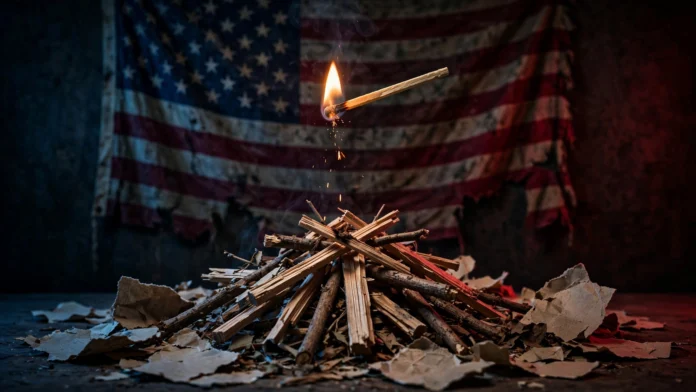
Pape’s own language for what this means should end the debate about whether words matter. In his report he writes that while there is a gap between supporting violence and committing it, “support acts as kindling, creating a situation where individuals inclined towards violence may conclude that violence is both necessary and appropriate.” Kindling. That is the permission structure, described by the man who measures it.
And when his team asks the people who endorse force what they actually mean by it, 55 percent of them are talking about lethal force, including assassination. This is not venting. A CPOST analysis of charged threats against members of Congress found they jumped 600 percent from 2016 to 2017 and never came back down.
Pape laid out the full argument in an interview with Triggernometry published October 28, 2026, titled “This Is the Age of Political Violence.” Watch it here:
The last decade supplied the bodies to match the trend line, from both directions.
From the right: a mob stormed the Capitol on January 6, 2021, hunting for lawmakers and chanting about the vice president. A man broke into the Pelosi home in 2022 and fractured the Speaker’s husband’s skull with a hammer. A militia plotted to kidnap Michigan’s governor in 2020. Gunmen motivated by racial and anti-immigrant hatred murdered worshippers in Pittsburgh in 2018, shoppers in El Paso in 2019, and shoppers in Buffalo in 2022. In June 2025, a man in Minnesota assassinated a Democratic state lawmaker and her husband and shot another lawmaker and his wife.
From the left: a Bernie Sanders supporter opened fire on Republican congressmen at a baseball practice in 2017 and nearly killed Steve Scalise. The summer of 2020 brought months of riots, torched businesses, and a deadly autonomous zone, all waved along by politicians who called it mostly peaceful. In December 2024, Luigi Mangione shot a health insurance CEO in the back on a Manhattan street, and a significant slice of the country treated him as a folk hero. An Emerson poll taken days after the killing found 17 percent of voters called it acceptable, including 22 percent of Democrats. A survey of college students found 48 percent calling it justified.
Note the difference in that last item. The permission structure is not just the act. It is the applause afterward.
Which brings us to the present, and to a conclusion that will make some readers uncomfortable. Both sides spent a decade teaching their fringes that the other side is an existential enemy. But in the last five to ten years, and especially in the last two, the violence that has actually manifested, assassinations carried out, assassinations attempted, and violence openly celebrated, has come disproportionately from the left.
Charlie Kirk was assassinated on a college campus in September 2025 for the crime of debating students. Two gunmen tried to kill Donald Trump during the 2024 campaign. ICE officers were ambushed in Texas in July 2025 and sniped at in Dallas that September by attackers who wrote their politics on their equipment. Teslas and dealerships were firebombed across the country in the spring of 2025 because of who owned the company. A man firebombed the Pennsylvania governor’s residence in April 2025. A man murdered two Israeli embassy staffers in Washington in May 2025 and shouted his motive to the cameras. An attacker firebombed a march for Israeli hostages in Boulder a month later, killing an 82-year-old woman.
Meanwhile the polling asymmetry keeps widening. Support for force against Trump rose 50 percent in a single year in Pape’s tracking, and at 44 percent, Democratic support for removing a president by force is not a fringe position anymore. It is two of every five voters in one of the two major parties.
The right has its killers and its own work to do on its rhetoric. That record is above, in print, and I am not excusing any of it. But honesty about the trend requires saying where the energy is right now. The left spent years insisting that words are violence. Its own words have spent the same years building a permission structure, fascist, Nazi, threat to democracy, existential, and its fringe has been acting on the permission at a rate the right’s fringe currently does not match.
Pape’s most hopeful number is that more than 70 percent of Americans still reject political violence outright, and about three quarters want congressional leaders to condemn it together, on the record. That majority is the only counterweight there is. Permission structures are built by rhetoric, and they can be dismantled by it, but only by leaders willing to tell their own side’s fringe that it is wrong, in public, without a “but” attached.
Until that happens, the kindling keeps piling up, and somebody at the edge of the crowd keeps finding a match.
Sources:
Robert A. Pape, “Violent Populism in a Fractured America,” Chicago Project on Security and Threats, University of Chicago, October 1, 2026 (August 2026 NORC survey, n=2,218): https://cpost.uchicago.edu/publications/cpost_august_2026_survey_report/
Robert Pape interview, Face the Nation, September 14, 2025 (39 percent of Democrats, 55 percent lethal force, 24 percent of Republicans figures, from the May 2025 CPOST survey)
“This Is the Age of Political Violence”, Dr Robert Pape, Triggernometry, October 28, 2026 (embedded above): https://www.youtube.com/watch?v=6oxzjRq2bE8
Emerson College poll, December 2024 (17 percent of voters, 22 percent of Democrats, found the killing of Brian Thompson acceptable); Generation Lab survey of college students, December 2024 (48 percent justified)