
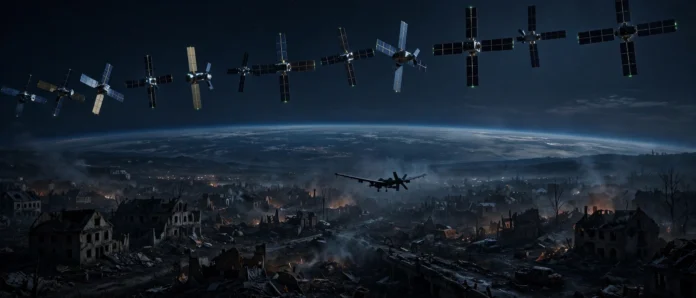

On the night of October 13, Ukrainian military terminals on the Starshield network picked up a new rule: move faster than about 100 miles per hour and the connection dies. No warning came first. Ukraine’s armed forces found out by filing a complaint, and presidential adviser Serhii Beskrestnov confirmed what SpaceX support told them: a speed limit had been switched on for terminals in motion.
The timing could hardly have been worse. Ukraine’s newest air defense weapon is the interceptor drone, a small, fast hunter that runs down Russia’s jet-powered Shahed attack drones, which fly at 300 to 400 kilometers per hour. An interceptor that loses its satellite link at 160 cannot catch them. “Today our interceptors are not working because there is a speed limit,” President Zelensky said. Kyiv also ran the test that tells you this was deliberate: terminals driven at 180 km/h inside European Union countries held their connection. Only inside Ukraine did the link drop. As of this week, Zelensky says the restrictions are still in place, while other Ukrainian sources say full function has been restored. Nobody outside the room actually knows, which is rather the point of this article.
Within days, the story had been sorted into its tribal shapes. The Wall Street Journal, citing unnamed officials, reported that Elon Musk personally ordered the slowdown after criticizing Zelensky. The Telegraph reported that Musk proposed it and President Trump agreed. Reuters, a week earlier, had unnamed officials saying the order came from inside the White House, and an unnamed senior official replying that no such request was ever made by the president. Every named official is on the other side of the anonymous ones. Trump: “It wasn’t me, and I don’t think it was Elon.” Defense Secretary Hegseth: the Pentagon issued no directives, and Starlink has discretion under its terms of service. Secretary of State Rubio: Washington had no prior knowledge. Musk: speed and usage limits on Starshield are decided by the US military and ultimately the president.
Notice what just happened. Four separate anonymous accounts accuse four different actors, the named principals all deny it, and each political tribe simply chose the version with its preferred villain. Half the country is certain a billionaire flipped a switch out of spite. The other half is certain he could not have, because their guy says so. Both are building on sourcing that would get laughed out of any courtroom in America: people familiar with the matter, officials who will not give their names. The one finding every account agrees on is the embarrassing one. A military network that an allied army depends on for air defense had a war-changing setting altered, and a week later, no institution in the chain, not the White House, not the Pentagon, not the contractor, will say on the record who did it. That vacuum is the scandal. It is also the part nobody wants to lead with, because a vacuum does not fit on a campaign mailer.
The Musk framing also erases the most inconvenient fact in the whole story: this capability exists because Ukraine begged for it. In January, Russian forces were bolting Starlink terminals onto long-range strike drones, including Shaheds, which made them nearly immune to Ukrainian jamming. After a Russian strike on a passenger train in the Kharkiv region killed at least five people on January 27, SpaceX rebuilt its controls: the constellation itself began measuring each terminal’s true speed, service was cut to fast movers, and then unregistered terminals in Ukraine were shut off entirely, leaving only a verified list built with Kyiv. Ukraine’s defense minister publicly thanked SpaceX’s leadership and Musk by name for the speed of the response. Russian military bloggers admitted their command and control had collapsed in places. The speed limit, in other words, is not a weapon invented to hurt Ukraine. It is Ukraine’s own shield, built at Ukraine’s request, in about ten days, by the company everyone is now accusing of treason for possessing it. The live question is who aimed it, or mis-aimed it, in October, and that question has an answer somewhere in a contract chain. It will not be found by yelling about one man’s tweets.
Which brings up what Starshield actually is. It is not Musk’s personal toy. It is the US government’s military satellite service, run under Pentagon contract, and Germany pays the bill for Ukraine’s access under a contract running to April 2027. The drones going dark over Ukraine are flying on an American government service, paid for by a European ally, operated by an American contractor, inside a war America is supplying. If a setting on that service changed without warning in the middle of Russia’s winter bombing campaign, the investigation writes itself: who authorized it, under what contract clause, with what notice to the customer. Republican Rep. Brian Fitzpatrick is demanding witnesses under oath, and for once the oversight instinct is the right one. Sen. Chris Coons, meanwhile, is talking about subpoenas conditional on Democrats winning the Senate, which tells you how much of this is inquiry and how much is positioning for November.
And then there is the fashionable cure: nationalize it. Take the network away from the billionaire and give it to the state. Set aside that the state in question just spent a week unable to explain whether it ordered the restriction, denied ordering it, or knew it happened. The proposal concedes the very thing it claims to fix. The danger here was never that one man owns the switch. It is that a switch exists at all that can ground an ally’s air defense overnight, held by anyone, elected or not. Moving the switch into a government office does not retire the danger. It just makes the next unexplained change a sovereign act instead of a customer service incident, and hands the same lever to whoever wins the next election, to use on whichever side they favor.
The dependence underneath all of this is the part Washington least wants to discuss, because both parties built it. Ukraine fields roughly 50,000 Starlink terminals. Europe’s alternative, Eutelsat’s OneWeb, has fewer than 1,000 terminals in country and a constellation about one sixteenth the size. The EU’s own sovereign network, IRIS², is not launching until 2029. For four years, American policy outsourced the nervous system of an allied war effort to a single commercial constellation because it was the best technology on Earth and nobody else had built one. That was a bipartisan decision, renewed under two administrations, and it worked brilliantly right up until the week it didn’t. Yelling about Musk is easier than admitting that. It also changes nothing. The next speed limit, whoever sets it, will land on the same 50,000 terminals, in the same war, under the same contract nobody has read out loud yet.
So investigate, by all means. Subpoena the contract officers, the SpaceX engineers, the Pentagon staff, and yes, Musk too, and put them all under oath where anonymous officials cannot hide. But if the inquiry’s conclusion is prewritten by party, if one side needs a villain and the other needs a martyr, the country will learn nothing except what it already believed. The drones will still be flying at 160 kilometers per hour, wondering why.