
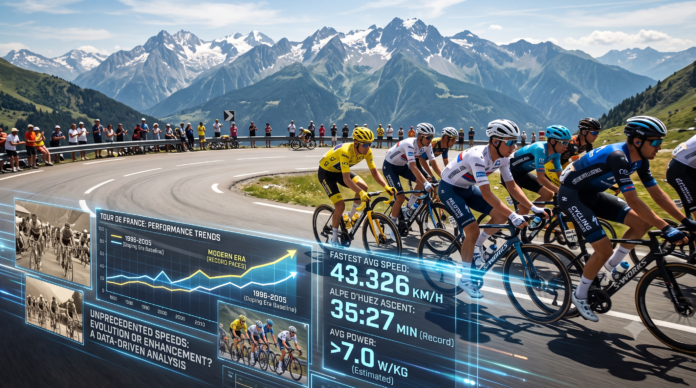

The evidence does not prove that today’s leading riders are using a new performance-enhancing drug. Race speeds and estimated power outputs cannot, by themselves, establish doping. But the scale, frequency and consistency of recent performances are now sufficient to justify serious scrutiny rather than automatic acceptance that better bicycles and better nutrition explain everything.
The most obvious trend is the Tour de France’s overall speed. Lance Armstrong completed the 2005 Tour at approximately 41.65 km/h, although that result was later stripped because of systematic doping. At the time, the performance represented the high-water mark of an era dominated by EPO, blood transfusions, testosterone, corticosteroids and sophisticated medical doping programs.
That benchmark has now been repeatedly surpassed.
The 2022 Tour was completed at approximately 42.10 km/h. The 2025 edition increased the record to 42.849 km/h over roughly 3,302 kilometers. The 2026 Tour appears to have raised it again to approximately 43.2 km/h over more than 3,300 kilometers. That is roughly 1.6 km/h, or almost 4%, faster than Armstrong’s 2005 pace.
Overall Tour speed is not a pure measurement of physiology. Course profile, wind direction, road surfaces, stage length, team tactics and the amount of time spent in a protected peloton all matter. Modern bicycles are more aerodynamic. Tires have lower rolling resistance. Clothing, helmets, pacing models and rider positioning have improved. Even so, a nearly 4% increase is substantial in a mature sport where marginal equipment improvements are normally measured in watts rather than whole kilometers per hour.
The mountain data are more difficult to dismiss because gravity reduces the importance of aerodynamics and drafting.
Marco Pantani’s approximately 36:40 ascent of Alpe d’Huez in 1995 stood for three decades as one of cycling’s most notorious benchmarks. Pantani raced during the height of the EPO era and was later recorded with a hematocrit of more than 60% during the 1995 season. In 2026, Tadej Pogačar reportedly climbed the same mountain in approximately 35:26—about 74 seconds faster.
Estimated power calculations placed the effort close to 7 W/kg for approximately 35 minutes. These numbers are models rather than direct power-meter files, but even allowing for reasonable error, the performance belongs at the extreme upper edge of anything previously observed in professional cycling.
Plateau de Beille provides an even more striking comparison. Pantani climbed it in approximately 43:20 in 1998. In the 2024 Tour, Pogačar completed the ascent in approximately 39:50, improving the EPO-era benchmark by about three minutes and 30 seconds, or roughly 8%.
One independent performance model estimated Pogačar’s effort at 6.98 W/kg for almost 40 minutes after nearly five hours of racing and several earlier climbs. Jonas Vingegaard, who lost more than a minute, was estimated at 6.85 W/kg. In other words, the second-place performance was itself among the strongest climbing efforts ever modeled.
That is important because the anomaly is no longer limited to one rider or one climb. Veteran professional Warren Barguil recently summarized the change bluntly: producing approximately 6 W/kg once made a rider elite; in the present peloton, that level may only make him a domestique. Today’s leaders are approaching 7 W/kg for sustained periods late in mountainous stages.
Flat-stage speeds show the same direction of travel, although they are more affected by wind and tactics. Mario Cipollini’s 1999 stage from Laval to Blois averaged approximately 50.35 km/h and stood for 27 years as the fastest non-time-trial road stage in Tour history. In 2026, Stage 11 covered approximately 161 kilometers at 50.91 km/h.
That record had favorable conditions, including a tailwind and an aggressive chase, so it should not be treated as direct evidence of doping. But it forms part of a broader pattern: the peloton is riding faster overall, climbing faster after greater accumulated workloads, and recovering well enough to repeat exceptional performances across consecutive stages.
There are legitimate reasons for part of this improvement.
Modern riders commonly consume 90–120 grams of carbohydrate per hour, compared with much lower and less systematically managed intake in earlier eras. Research has shown that mixed glucose-fructose feeding can improve carbohydrate oxidation and endurance performance; one controlled cycling study reported an approximately 8% improvement compared with glucose alone under its specific testing protocol.
Teams now use altitude camps, heat acclimation, aerodynamic testing, continuous glucose monitoring, individualized hydration, improved sleep protocols and year-round power-based training. Talent identification also begins earlier, and riders arrive at the WorldTour with years of structured development.
These developments matter, but they do not eliminate the questions. Nutrition may allow a rider to express more of his physiological capacity late in a stage; it does not create unlimited aerobic capacity. Aerodynamics strongly affect flat speed but are less explanatory on steep climbs. Lighter equipment helps, but bicycles have minimum-weight restrictions. Better training produces improvement, but it does not necessarily explain why riders are now surpassing benchmarks established during an era of medically organized blood doping.
There is also a concrete reason to question whether the next generation of enhancement has already arrived.
During the 2024 Tour, it emerged that several leading teams possessed carbon-monoxide-rebreathing equipment. In legitimate laboratory use, a small controlled dose of carbon monoxide is used to measure total hemoglobin mass. However, repeated inhalation may induce hypoxia and stimulate the body to produce additional red blood cells, potentially amplifying the effects of altitude training without injecting EPO or transfusing blood.
No public evidence proves that a Tour contender abused the method. Nevertheless, the concern was serious enough that the UCI prohibited repeated CO inhalation in February 2025. WADA subsequently added nondiagnostic, performance-enhancing carbon-monoxide use to its prohibited methods for 2026.
That sequence matters. Sports regulators normally do not prohibit a method unless it is considered potentially performance enhancing, medically dangerous or contrary to the spirit of sport. CO exposure may therefore represent one example of a new frontier: methods designed to manipulate oxygen transport while remaining difficult to distinguish from legitimate altitude adaptation.
Other possibilities include extremely small doses of established drugs, short-half-life substances administered outside normal testing periods, manipulation of plasma volume, undisclosed peptide hormones, gene-expression techniques or compounds for which laboratories do not yet have validated detection methods. These remain hypotheses, not proven explanations.
Testing has improved. The Athlete Biological Passport tracks changes in blood variables over time, and the International Testing Agency planned approximately 350 out-of-competition tests before the 2025 Tour and roughly 600 blood and urine samples during the race. Samples are also stored for future reanalysis.
But cycling history demonstrates that negative tests are not proof that no doping occurred. Armstrong passed hundreds of controls. EPO use preceded a reliable direct test. Microdosing and transfusion protocols were repeatedly adapted to testing schedules. Detection technology generally reacts to innovation rather than anticipating it.
The responsible conclusion is not that every record proves doping, nor that any particular rider is guilty. The responsible conclusion is that current performances have reached a level at which extraordinary transparency should accompany extraordinary results.
Teams and riders seeking credibility should voluntarily release verified power files, rider and equipment weights, altitude-camp records, longitudinal hemoglobin-mass data, carbon-monoxide testing records and independent physiological testing. Anti-doping authorities should use power-data anomalies to direct testing, conduct unpredictable overnight controls when legally justified, expand long-term sample storage and publish more detailed testing statistics.
Modern cycling may be witnessing the combined effects of exceptional athletes, superior nutrition, improved aerodynamics and more scientific preparation. It may also be witnessing another enhancement method that current testing does not adequately detect.
The numbers cannot tell us which explanation is correct. They can tell us that unquestioning acceptance is no longer an intellectually serious position.