
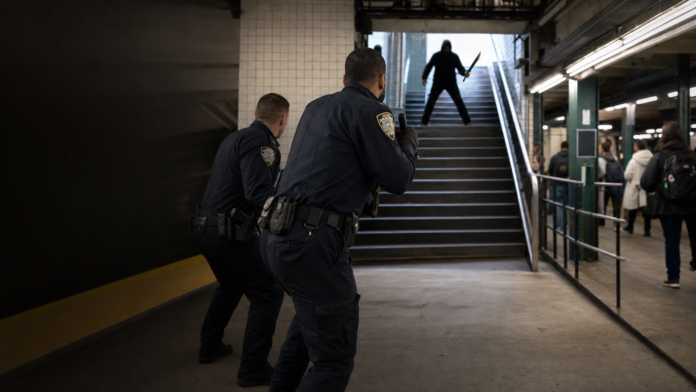

The NYPD body-camera footage from the Grand Central machete attack raises a blunt question: when an armed suspect has already slashed multiple people and still refuses to drop the weapon, how long should police be expected to wait before using deadly force?
In this case, the answer should be clear. The officers were justified in shooting the suspect. In fact, the footage supports a serious argument that deadly force could have been used sooner.
According to police and news reports, the April 11, 2026 attack at the 42nd Street-Grand Central subway station left three people injured before officers confronted the suspect, Anthony Griffin. The victims were older adults, and their injuries included severe lacerations and a skull fracture. By the time police encountered Griffin, they were not responding to a hypothetical threat. They were facing a man reportedly armed with a machete who had already used it against innocent people.
A Machete Attack Is a Deadly Force Encounter
Public debates about police use of force often become detached from the physical reality of a violent encounter.
A machete can kill or permanently injure someone in seconds. At close range, an officer does not have the luxury of endless analysis. A suspect with a raised blade can close distance quickly, and one strike can cause catastrophic damage.
That matters here.
Police officers do not have to wait until they are stabbed or slashed before defending themselves. They do not have to wait for a fourth victim before stopping someone who has already attacked three people. When an armed suspect continues to pose an immediate danger, deadly force can be legally and morally justified.
The NYPD Officers Tried to De-Escalate
The footage and reporting show that officers repeatedly ordered Griffin to drop the weapon. Police Commissioner Jessica Tisch said officers gave at least 20 commands before shots were fired.
That is not the picture of officers rushing recklessly into a shooting. It is the picture of officers trying to end a deadly confrontation without firing, even after the suspect had allegedly injured multiple subway riders.
But de-escalation has limits.
De-escalation requires some willingness from the person creating the danger. If an armed suspect ignores commands, keeps the weapon raised, and continues moving in a threatening way, officers cannot talk forever while the risk grows around them.
Why Deadly Force Was Justified
The justification for deadly force in the Grand Central machete shooting rests on several facts reported about the encounter:
- The suspect had allegedly already attacked three people.
- He was armed with a large bladed weapon.
- Officers repeatedly ordered him to drop it.
- He did not comply.
- He continued to present an immediate threat in a crowded transit setting.
Those facts matter more than hindsight commentary from people watching video frame by frame after the danger has passed.
Police are expected to protect the public in real time. That includes making fast decisions when a violent threat is unfolding in front of them. In this case, allowing the suspect more time and more space could have meant another injured commuter or an injured officer.
The Cost of Police Hesitation
The more difficult question is not whether the shooting was justified. It is why officers appeared to wait so long before stopping a threat that had already become violent.
Part of the answer may be training and discipline. Officers are trained to use force only when necessary, and restraint matters.
But it is also fair to ask whether years of anti-police rhetoric have changed the way officers assess personal risk, not just physical risk. In New York City especially, police know that any use of force can become a public controversy before investigations are complete. They know video clips can be judged instantly, politically, and emotionally.
Criticism of police misconduct is necessary. Bad shootings should be investigated. Officers who abuse authority should be held accountable.
Still, there is a difference between accountability and creating a climate where officers fear decisive action even during an obvious deadly threat. If police believe that every force decision may be treated as proof of wrongdoing before the facts are weighed, hesitation becomes more likely.
And hesitation in a machete attack is not an abstract policy concern. It can get people hurt.
New York City Needs Clarity on Violent Threats
New Yorkers deserve police officers who show restraint when restraint is possible. They also deserve officers who act decisively when innocent people are in immediate danger.
Those principles are not opposites.
A city can demand professionalism from police while also recognizing that violent attackers sometimes leave officers with no safe alternative. A city can support de-escalation without pretending that every armed confrontation can be talked down. And a city can insist on accountability without treating every justified use of force as a scandal waiting to happen.
The Grand Central machete attack is a reminder that police work is often judged in slow motion even though it happens at full speed.
Conclusion
The NYPD officers who shot the Grand Central machete attacker were justified in using deadly force. Based on the reported facts, they faced an armed suspect who had already injured three people, refused repeated commands, and continued to pose a serious threat.
That is exactly the kind of encounter where deadly force may be necessary to protect officers and the public.
The lesson should not be that police need to hesitate longer. The lesson should be that when a deadly threat is clear, officers must be able to stop it before someone else becomes the next victim.