
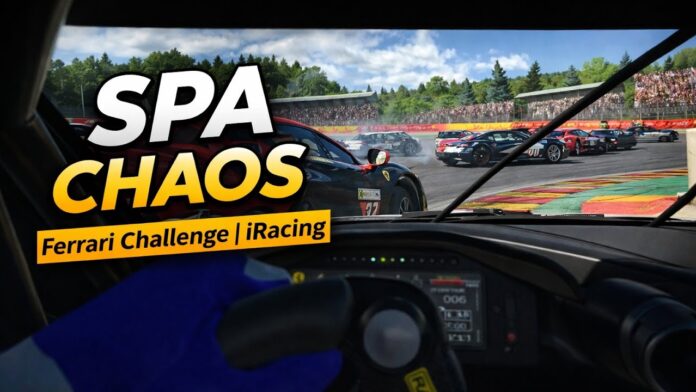

Nine years into iRacing, I have 339 starts in Sports Car alone, 3,200 laps turned, 93 of them led, 5 wins, and 9 pole positions to my name. My iRating has climbed, collapsed, and climbed again — bottoming out near 840 before grinding back to an all-time high of 1,560. That is not a casual gaming hobby. That is the kind of investment you only make in something that genuinely gets under your skin.
The physics: why it actually feels like driving
What keeps me coming back, more than anything else, is the realism. iRacing does not feel like a video game — it feels like driving. Every track is built from real-world laser scan data, every car behaves like its physical counterpart, and the physics engine will expose bad habits that a more forgiving sim would let you hide. I have logged over 600 laps in Formula cars on top of my Sports Car racing, and the discipline each category demands is completely different. You cannot fake your way through a fast lap. The platform teaches you to be a better driver whether you intend it to or not, and that loop of improvement is genuinely addictive.
Every track on iRacing is built from LiDAR laser scan data collected at the actual circuits — the same technology surveyors use to map terrain. You are not driving an approximation of Daytona or Spa. You are driving a millimeter-accurate digital replica.
iRating: the number that makes it matter
The iRating system is what separates iRacing from every other online racing platform on the market. Your rating is a live reflection of how you perform against your competition, and it moves after every single race. I know what it feels like to watch that number crater — going from 1,260 down to 840 over a brutal stretch of races was a gut punch. Earning it back point by point over the following months, because you have to race well consistently and not just occasionally to move the needle, is its own kind of satisfaction. Sitting at an all-time high of 1,560 after that kind of swing means something that no participation trophy system could ever replicate.
The Safety Rating is another feature that sets iRacing apart in a way casual racing games never attempt. Drivers are accountable for their behavior on track, and that accountability creates a noticeably different quality of racing compared to anything unranked. With an incident rate of just over five per race in Sports Car — lower than you would expect from a competitive online grid — the racing is mostly clean, mostly respectful, and mostly decided by actual pace. When the system works, it produces racing that looks and feels like the real thing.
VR transforms it into something else entirely
If you have a VR headset, iRacing becomes something else entirely. Depth perception, spatial awareness, the ability to judge a braking zone by feel rather than by a reference cone on a flat monitor — it transforms the experience from a simulation into something that feels genuinely immersive. Running a full race in VR is the closest most people will ever get to actually sitting in a race car, and iRacing’s fidelity makes that experience hold up in a way that lower-quality sims simply cannot.
“Running a full race in VR is the closest most people will ever get to actually sitting in a race car.”
That said, VR is the most hardware-demanding way to run iRacing, and it is worth knowing exactly what you are getting into before you build or buy a rig. iRacing is notoriously CPU-bound — its physics engine prioritizes accuracy over rendering efficiency, which means weak single-thread CPU performance will bottleneck you even with a top-tier GPU. Plan your build around that reality.
PC requirements: what you actually need to run it well
iRacing’s official minimum specs will get you in the door, but they will not give you a competitive or immersive experience. The recommended specs are the real baseline for clean, consistent performance — and if VR is in your plans, treat those recommended specs as your absolute floor, not your target. The platform requires Windows 10 or 11 (64-bit only); Microsoft ended support for Windows 10 in October 2025, making Windows 11 the practical requirement going forward.
| Tier | CPU | RAM | GPU | Storage |
|---|---|---|---|---|
| Minimum | i3-13100 / Ryzen 5 5500 (4-core) | 16 GB | 4 GB VRAM (GTX 1060 class) | 25 GB |
| Recommended | i5–i7 / Ryzen 5–7 (6-core+) | 32 GB | 8 GB VRAM (RTX 3070 / RX 7800 XT) | 50 GB SSD |
| VR / High-End | i7-14700K / Ryzen 7 7800X3D | 32–64 GB DDR5 | RTX 4070 / RX 9070 or better | 50+ GB NVMe SSD |
iRacing is heavily CPU-bound due to its physics engine. Even an RTX 4090 will underperform if paired with a CPU that has weak single-thread performance. When budget forces a trade-off, prioritize CPU clock speed and single-core performance over GPU tier.
A proper sim rig compounds the cost further. A direct-drive wheel, load cell pedals, and a VR headset push total investment into the thousands — before the subscription and iRacing’s à la carte content model for cars and tracks. None of this is cheap. But for the fidelity you get in return, the math holds if you are serious about it.
Where it falls short: the honest frustrations
iRacing is not without its frustrations, and after nine years I have earned the right to be direct about them. The biggest one is that a single reckless driver can derail an otherwise clean race in seconds. You can run 30 laps of disciplined, consistent racing and get turned around on the final corner by someone who had no business being in your lap. The incident gets split — or worse, lands on you — and there is nothing you can do about it. Contact equals incident points regardless of who caused the contact, and until iRacing invests in real fault-detection logic, clean drivers will keep absorbing penalties they did not earn.
Lower than you would expect from a competitive online grid. When the Safety Rating system works, it keeps racing clean. When it doesn’t, a clean driver pays for someone else’s mistake.
Higher contact rate reflects the nature of open-wheel racing — tighter tolerances, no bodywork buffer, and nowhere to go when someone makes a mistake within your racing line.
The cost is also worth naming plainly. The subscription gets you in the door, but the platform’s à la carte model for cars and tracks adds up fast if you want to race across multiple series. The barrier to entry is steeper than it needs to be, and iRacing would do well to make the on-ramp more accessible for newcomers who are not yet sure how deep the rabbit hole goes.
Bottom line: nine years in, still the best there is
The laser-scan track data and physics engine are unmatched. iRacing does not feel like a game — it feels like driving, and that fidelity is what earns nine years of continued investment.
The iRating system creates real stakes. Watching your number crater and grinding it back produces a feedback loop no other sim has come close to replicating.
VR is the definitive way to experience iRacing — but demands serious hardware. Target a Ryzen 7 7800X3D or i7-14700K, 32 GB RAM, and an RTX 4070-class GPU as your practical VR floor.
The incident system has one critical flaw: it cannot assign fault. Clean drivers absorb penalties they did not earn until iRacing builds real fault-detection logic into the platform.
Total cost of entry — subscription, content, wheel, pedals, VR headset — is steep. Go in knowing it is a serious commitment, not a casual purchase, and budget accordingly.
iRacing is the best competitive racing simulator in existence. Nine years, 400-plus starts, and an all-time-high iRating say so — and no other platform has come close to changing that verdict.