
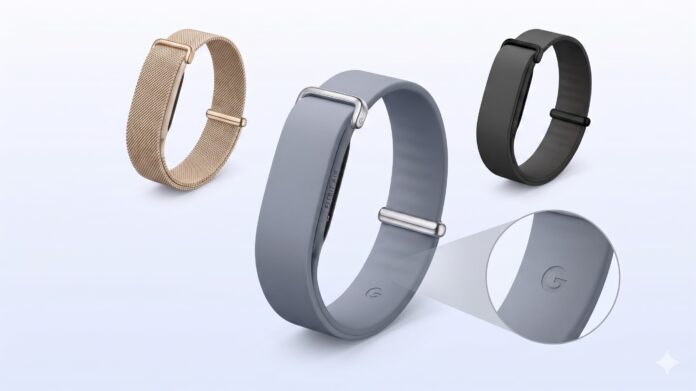

Google has done something the fitness tracker market hasn’t seen in years: a product that forces a real conversation. The Fitbit Air — launching May 26, 2026 at $99 — is a completely screenless biometric band designed to go head-to-head with WHOOP, and it does so without requiring a subscription to unlock its core functionality. That single design decision changes the math for every serious fitness tracker buyer on the market.
Design and Hardware: Small by Design
The Air is built around a 5.2-gram sensor module — 12 grams total with band — that slots into a wrist strap and presses its sensor array against your skin. There is no display, no touchscreen, no buttons beyond a vibration motor for silent alarms and a double-tap gesture for basic interaction. Google shrunk the form factor by roughly 25% compared to the Fitbit Luxe and came out noticeably narrower than WHOOP 5.0. The result is a pebble you forget you’re wearing, which is exactly the point for a 24/7 health monitor.
Water resistance is rated to 50 meters (5ATM), making it swim-proof without hesitation. Band options at launch are wrist-based only. A bicep band is confirmed for later in 2026 — an important gap to flag for contact sport athletes or anyone who wants off-wrist placement during training. WHOOP holds that advantage for now.
Sensors and Technical Specs
The Fitbit Air packs a full biometric sensor suite into its compact housing. Running continuously, 24/7:
The combination of HRV, skin temperature, SpO2, and continuous heart rate running in parallel is what enables the higher-order metrics: Cardio Load, Readiness Score, and sleep stage analysis. Google has not disclosed the specific processor or chip architecture, but the 7-day battery life with full continuous sensing suggests aggressive power management in the silicon. The heavy lifting — pattern recognition, AI coaching, trend analysis — is offloaded entirely to the Google Health app. The hardware is a sensor collector; the intelligence lives in software.
Battery Life and Charging
Seven days of typical battery life with continuous tracking is competitive and genuinely practical. The charging story is where Google made a smart call: 5 minutes of charging delivers a full day of use, and 0–100% takes 90 minutes. For a band you’re meant to wear around the clock, fast top-off matters more than the headline number. A 5-minute charge during a shower means you’re back on wrist before the day starts, without breaking tracking continuity.
The Fitbit Air charges to a full day of use in just 5 minutes — a critical design decision for a sensor platform meant to track sleep, recovery, and activity without gaps.
Software: Google Health + Gemini
Google is retiring the Fitbit app on May 19, 2026 and migrating everything to Google Health — the renamed, rebuilt home for all of Google’s health data. The Gemini-powered Health Coach, which ran in public preview with approximately 500,000 participants since October 2025, comes out of beta alongside the Fitbit Air launch.
The free tier is more generous than most competitors: heart rate, sleep stages, steps, SpO2, skin temperature, Cardio Load, and Readiness Score are all included with hardware purchase alone. Google Health Premium at $9.99/month unlocks the Gemini Health Coach, which adds personalized workout planning, conversational health Q&A, deeper sleep analysis, recovery recommendations, and trend analysis. Works with both Android and iOS, though Google ecosystem integration (Pixel Watch data layering, Calendar-aware scheduling) runs deeper on Android.
Fitbit Air vs. WHOOP 5.0: The Real Comparison
This is where the Fitbit Air’s case is strongest. WHOOP requires a membership subscription — the cheapest annual tier runs $169/year. Over three years, WHOOP costs between $500 and $1,000 more depending on membership level. The Fitbit Air is $99 one-time with meaningful free-tier functionality from day one.
| Category | Fitbit Air | WHOOP 5.0 |
|---|---|---|
| Price | $99 one-time | $169–$349/year subscription |
| No-subscription tier | Full core metrics free | App requires membership |
| Sensor accuracy | Competitive; edge to WHOOP for elites | Industry-leading for pro athletes |
| Body placement | Wrist only at launch | Wrist, bicep, calf, apparel |
| Battery life | 5–7 days | 5–7 days |
| AI coaching | Gemini Health Coach (Premium) | WHOOP Coach (subscription) |
| Ecosystem | Google Health, Android + iOS | WHOOP app, Android + iOS |
| Weight | 12g (with band) | ~10g sensor only |
Verdict
The Fitbit Air is a well-executed first move in a category Google has been slow to enter. The hardware is lean, the sensor suite is complete, the pricing is disruptive, and the Gemini-backed software is the most credible AI health coaching available in a consumer wearable today. The gaps — wrist-only placement at launch, a Health Coach that is still maturing — are real but not disqualifying for the majority of buyers.
WHOOP remains the better instrument for competitive athletes who need the tightest possible data and flexibility in wear position. But for anyone who’s been skeptical of WHOOP’s subscription model, wants a secondary tracker alongside a smartwatch, or is simply looking for a capable 24/7 health band without ongoing fees, the Fitbit Air makes a strong argument that’s hard to dismiss.
What the Fitbit Air actually means for the market
The subscription model for screenless trackers is under pressure. At $99 with full free-tier functionality, the Fitbit Air makes WHOOP’s mandatory membership a much harder sell to casual and intermediate fitness users.
Google Health is now a serious platform. The app rebrand, Gemini Health Coach launch, and Fitbit Air hardware are a coordinated move — not a product refresh. Google is building an AI health stack, and the Fitbit Air is its front-end sensor.
The hardware-only model is validated. Twelve grams, seven days, full biometrics, 50m water resistance — the Air proves you don’t need a screen or a subscription to build a credible 24/7 health monitor.
Body placement flexibility is the remaining gap. A wrist-only device at launch limits the Air’s appeal for contact sport athletes and gym users who rely on bicep or calf placement. The confirmed 2026 bicep band needs to ship fast.
This is Google’s most purposeful wearable since the Pixel Watch debut. Unlike past Fitbit iterations, the Air has a clear competitive target, a differentiated price point, and software that can improve post-launch. The bones are right.
Ships May 26, 2026. At $99, it’s the most compelling entry point in screenless fitness tracking to date.