
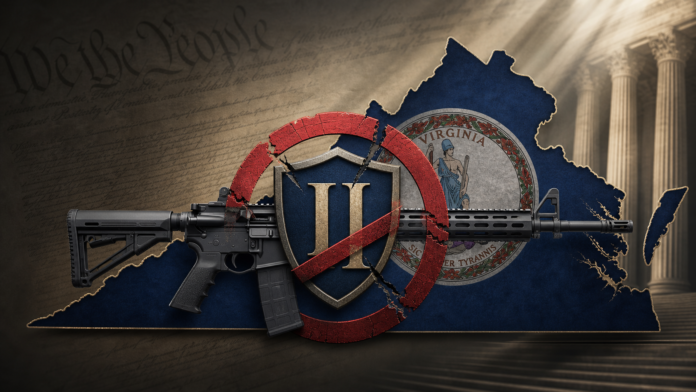

Virginia has now crossed a line that every defender of constitutional liberty should recognize. Gov. Abigail Spanberger signed legislation banning the future sale and manufacture of so-called “assault firearms,” including many AR-15-style rifles, with the law set to take effect July 1, 2026. Gun-rights groups responded almost immediately with lawsuits, and they are right to do so.
This is not a minor regulation. It is not a background check tweak. It is a direct attack on one of the most common, popular, and constitutionally protected categories of firearms in America.
Supporters of the ban use the phrase “assault firearm” as if it settles the debate. It does not. The AR-15 is widely owned by law-abiding Americans for lawful purposes, including home defense, sport shooting, training, and collecting. Under the Supreme Court’s Second Amendment framework, that matters. The government does not get to ban arms simply because politicians dislike their appearance, their popularity, or their symbolic value.
The Second Amendment was not written to protect only antique muskets, boutique hunting rifles, or whatever firearms a legislature finds politically acceptable this decade. It protects the right of the people to keep and bear arms. A firearm does not fall outside that protection because it is modern, effective, or commonly chosen by citizens.
Virginia’s ban also exposes the deeper danger of “common sense” gun control rhetoric. Once lawmakers decide that a widely owned rifle can be prohibited because it is scary-looking or politically disfavored, the limiting principle disappears. Today it is AR-style rifles. Tomorrow it can be handguns, magazines, parts, private transfers, ammunition, or whatever else becomes the next target.
The state will argue that the law is about public safety. But constitutional rights are not erased by invoking good intentions. The First Amendment would not allow Virginia to ban a category of popular books because some people misuse words. The Fourth Amendment would not allow warrantless searches of every home because crime exists. The Second Amendment deserves the same seriousness.
The lawsuits now moving forward should force Virginia to answer the question it wants to avoid: where is the historical tradition that permits the government to ban commonly owned arms from ordinary, peaceable citizens? If the answer is thin, modern, or invented after the fact, the ban should fail.
Virginia was once seen as a state with deep roots in American liberty. This law moves it closer to the most aggressive gun-control states in the country. That is not moderation. It is escalation.
The courts should strike this ban down. Not because every policy question about guns is easy, and not because violence is not real, but because constitutional rights mean something precisely when politicians are most eager to override them.
Virginia’s AR ban is a war on the Second Amendment. Hopefully, the courts will call it what it is: unconstitutional.