
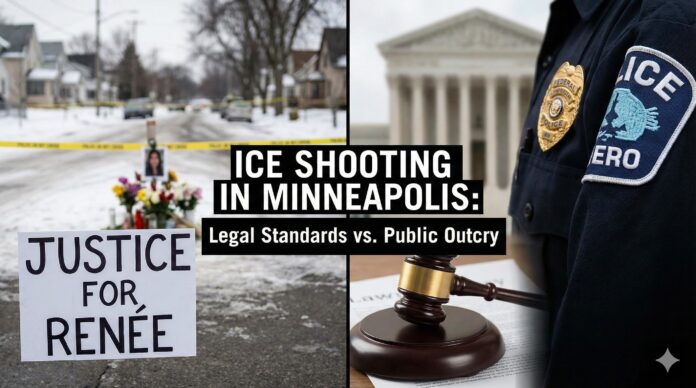

On January 7, 2026, an ICE Enforcement and Removal Operations agent fatally shot 37-year-old Renée Nicole Good during a federal immigration enforcement action in south Minneapolis. Federal officials state the agent acted in self-defense, asserting Good attempted to use her vehicle as a weapon against officers. Minnesota officials and activists dispute that account, citing bystander video and demanding an independent investigation. The incident has triggered nationwide protests and renewed debate over ICE’s role and federal use-of-force authority.
From a legal standpoint, the justification argument rests on settled constitutional doctrine rather than emotion or optics. Under federal use-of-force policy, ICE agents may use deadly force when they reasonably believe there is an imminent threat of death or serious bodily harm. That determination is judged from the perspective of a reasonable officer on the scene, not through hindsight or slow-motion video review. Deadly force is prohibited solely to prevent escape, but it is explicitly permitted to stop a perceived imminent threat.
That standard flows directly from the Supreme Court’s ruling in Tennessee v. Garner. While often mischaracterized as a restriction on police authority, Garner affirms that deadly force is constitutionally reasonable when an officer has probable cause to believe a suspect poses a significant threat of death or serious physical injury. The Court did not limit that threat to firearms. Courts have repeatedly recognized vehicles as deadly weapons when used, or reasonably perceived as being used, against officers. Officers are not required to wait until they are struck, pinned, or crushed before acting. The legal question is whether the threat appeared imminent in that moment, not whether later observers believe it was avoidable.
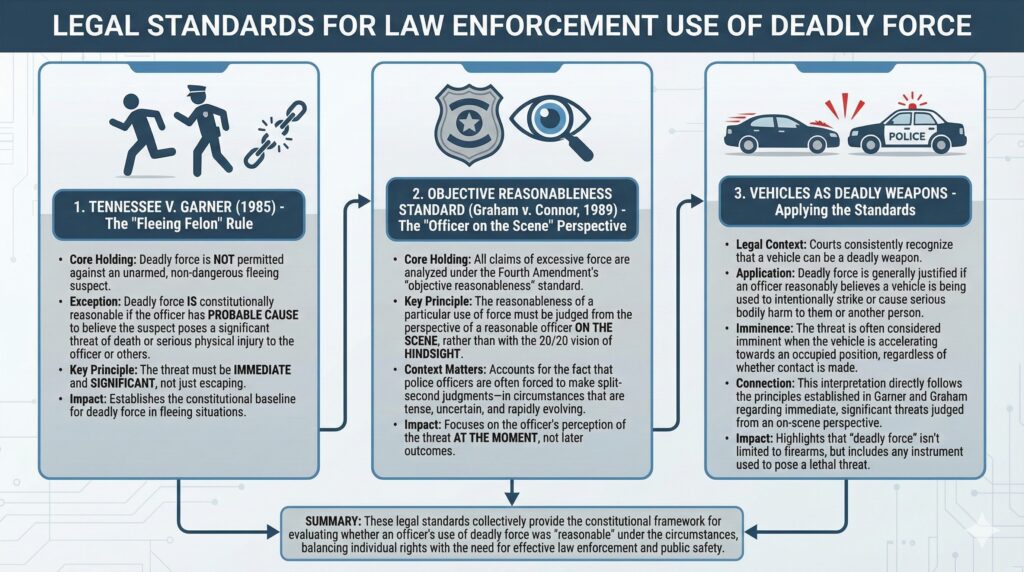
This principle has been reinforced repeatedly by the Supreme Court. In Brosseau v. Haugen (2004), the Court held an officer acted reasonably when she shot a fleeing suspect driving a vehicle, emphasizing that the danger posed to officers and the public justified deadly force even though the vehicle had not yet struck anyone. In Scott v. Harris (2007), the Court ruled that deadly force was reasonable to end a dangerous vehicle pursuit, explicitly recognizing that vehicles present a grave and immediate risk to life. More recently, in Plumhoff v. Rickard (2014), the Court unanimously held that officers did not violate the Fourth Amendment when they fired multiple rounds at a fleeing driver, noting that once a vehicle is used in a manner that threatens lives, officers are not required to disengage or gamble on the suspect stopping voluntarily.
Federal appellate courts have applied these rulings consistently. Officers standing near or in the path of a moving vehicle have repeatedly been cleared criminally and civilly when investigators concluded the officer reasonably perceived the vehicle as an imminent threat, even when post-incident video suggested the vehicle may have been turning or accelerating away. The controlling factor in these cases is not the eventual trajectory of the car, but the officer’s perception of immediate danger at the moment force was used.
ICE and DHS training reflects this legal reality. Vehicle assaults are among the most common causes of serious injury and death to law enforcement during arrest and enforcement operations. Rapid acceleration, directional movement toward officers, or attempts to force escape through an occupied position meet the threshold for deadly force under both policy and constitutional law. Whether the vehicle ultimately makes contact is legally irrelevant if the perceived threat was immediate.
What complicates incidents like this further is the role of public commentary from high-profile figures with no background in law enforcement training, use-of-force policy, or constitutional standards. Statements from celebrities and coaches such as Steve Kerr framing these encounters as intentional violence may resonate emotionally, but they distort reality. Reducing split-second decisions to moral indictments reinforces the false idea that officers have unlimited time, perfect information, and risk-free alternatives.
There is strong evidence that sustained rhetoric portraying law enforcement as malicious or illegitimate correlates with increased assaults on officers. FBI data since 2015 shows marked increases in ambush-style attacks and vehicle assaults during periods of heightened political and cultural hostility toward policing. Language matters. When lawful uses of force are prematurely labeled as murder, it shapes suspect behavior and raises risk before officers ever arrive on scene.
Even more troubling are similar statements from elected officials who have sworn an oath to uphold the Constitution. Public comments by Tim Walz and Minneapolis Mayor Jacob Frey condemning the incident before facts are fully established are not just irresponsible—they are dangerous. These officials are not activists. They are constitutional officers. Their oath obligates them to support due process, federal supremacy, and the rule of law, not to inflame public sentiment while investigations are ongoing.
When senior political leaders signal that federal agents are presumptively guilty, they undermine constitutional order and embolden resistance to lawful enforcement. That posture increases hostility toward officers on the ground and makes violent confrontations more likely, not less. Criticism of policy is legitimate. Prejudging individual officers is not.
Tragedy does not automatically equal illegality. Law, training, and precedent exist precisely because officers are required to make irreversible decisions in fractions of a second. Ignoring those standards after the fact does not make the next encounter safer. It makes it more volatile—and more likely to end the same way.